Description

My basic trading philosophy can be summed up by one simple quote:

"Trade the ticker, not the company" - Nate Michaud


Showing posts with label Trading Tips. Show all posts

Friday, June 8, 2018

Recapping My Best Trade Ever - $212,000 CVSI Long

Has it really been over a year since I wrote my last blog post? Wow, that's embarrassing. Well, I'm going to do a post recapping my CVSI trade, a record-best $212,000 gain for me, because there are so many great lessons to be learned from it. I would have recorded a video, but given the fact that everything microphone-related I own is now either broken or in Puerto Rico, I have little choice. 

There are really two sides to discuss when it comes to CVSI, the technical side and the fundamental side. Yes, the "Trading Tickers" guy has finally started looking at fundamentals. I've spent the last couple of years slowly improving my ability to read SEC filings and understand their significance, although I'm sure that I still have a long way to go. But in this specific case, the basic fundamentals I saw, combined with the technical chart setup on CVSI, led to one of the most picture-perfect long setups I've ever seen.

The Technical Side:

Does the term "Multiday Breakout" sound familiar to anyone? I hope it does, because it's one of the only long setups I've ever been good at or done videos and posts on. 

If you're looking at just the one year chart, CVSI's breakout was above the $.89 level, set on 4/26/18. 
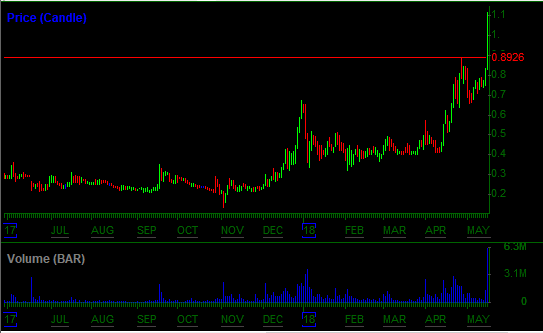


But if you go back a bit further on the chart, you'll see a beautiful multi-year high right at the $1 level. 


Yes, the chart goes back further and there is more overhead resistance (back when the ticker was CANV), but given the complete lack of volume on those trading days, those levels hardly concerned me at all.

I was a bit late seeing CVSI. It was on my OTC scanner, but I hadn't paid much attention to it because I was busy frustrating myself by trying to short HEAR and BLNK. I think it was eventually a tweet from @InvestorsLive or @OddStockTrader that made me take a closer look. I saw it coming up on the $1 breakout level, and I was very interested in longing it, just as I would be any other OTC stock. In fact, my first buys were right around $1 on May 15, as the stock was breaking out. I also added some shares into weakness on pullbacks and finished the day long 50,000 shares overnight. 


I expected a gap up and further spiking the next morning, but instead, CVSI gapped down and pulled back under $1, where it consolidated for two days. 


The stock was weak, it was red on the day, it wasn't continuing. Why didn't I just get out and move on? Well, I've been noticing lately that the OTC breakout pattern seems to be evolving a bit. In the past, I would have cut on a g/r move like this. But lately, I've been seeing a new pattern emerging - a shakeout g/r after the first breakout day and then recovery and continuation. It seems that more and more breakouts are doing this. More importantly, this red shakeout still seems to hold the original breakout level area, despite being red on the day (in this case, the $.90 area). So I adapted, and I've begun to reconsider risk levels I will use on day 2 of breakouts. It also helped that my average was around $1 and that I hadn't chased the spike up to the $1.12 closing price. In fact, I actually used these days to add to my position, and I wound up long a total of 159,800 shares from a $.986 average.

The only other thing really worth discussing on the technical side is my decision to sell. I was very patient with this play, mostly for fundamental reasons, which I'll discuss next. But also, I do know that breakouts can go parabolic, and I did believe it was possible the CVSI action could speed up. When that finally happened and the chart started to get extended near $2, I figured my time had come. I didn't want to hold through a giant parabolic, sit through a crash, and watch a huge gain disappear. I would then likely be stuck in a situation where I'd have to wait weeks, if not months, not knowing for sure if the stock would ever rally again. That didn't sound fun. So I paid myself 1/4 of my position on June 4 and took off the rest on June 5. I mostly paid myself into strength, taking off in chunks of 5,000 to 10,000 shares at a time. My average overall exit was $2.317.


The Fundamental Side:

I don't know if it was random curiosity or strategic planning that made me open CVSI's most recent 10-Q. All I know is that I found myself reading an OTC financial statement for one of the first times ever (I do it quite frequently for listed stocks). Here's a quick summary of the most basic things I quickly look for when opening a 10-Q and what I found for CVSI:

-Shares outstanding: 90,512,563
-Current assets: $9,541,937
-Total assets: $23,054,414
-Total liabilities: $5,018,468
-Stockholders' Equity (assets - liabilities): $18,035,946
-Product Sales (Revenue): $8,070,765
-Net Income: $619,334
-General quick-search through 10-Q for possible ways for the company to dilute and increase share count

While there is definitely much more information you can learn by reading a complete 10-Q or 10-K, the above info was more than enough for me and took me just a few minutes to find. My first reaction when looking at this was a bit of shock, due to the fact that the financials looked better than most listed stocks I research. It's pretty rare for me to see a small-cap company with positive net income. With revenues also above $8 million, it was clear that this company actually has and sells a real product. For once, I wasn't trying to buy a blatant pump.

From there, I looked through a few other things to get a clearer picture of the fundamental side. I looked back at the previous three quarterly reports to see what revenues and net income looked like. I quickly scanned twitter and the Ihub message board to see if anyone had anything intelligent to say about the company (and ignored the "TO THE MOOOOON" garbage all over the place). A few quick highlights of things I noticed:

- Revenues were steadily increasing every quarter, so the most recent quarterly statement obviously wasn't a one hit wonder.
- Net income was improving every quarter, and the biggest expense, "Selling general, and administrative" was holding steady around $4 million each quarter.
- On twitter, I found a mention of their earnings conference call and some things discussed in it. Instead of taking the tweeter's word for it, I found it and listened for myself.
- The conference call discussed how the remainder of their convertible debt had been eliminated.
- The presentation slides discussed how distribution channels increasing was why revenues were increasing. This was another reason not to think it was just a "lucky quarter."
- The conference call discussed plans to uplist to a major exchange late this year

Hopefully, by now you can understand a bit of why I was impressed. This was nothing like the 99% of the OTC trash I usually trade, this was a real company with real things going on, breaking to new multi-year highs. But I didn't drink the kool-aid yet; there still was one thing that concerned me, the market cap valuation.

For those unfamiliar with this term, market cap is calculated by multiplying the number of shares outstanding by the price of the stock. That's an easy enough number to find, great. But what do you do with it? When I saw that CVSI had a market cap of just over $90 million, what should that mean to me? I don't know how to decide whether that valuation is "fair" or not. So rather than stressing about that question, I took another approach. I decided to see how it stacked up compared to other marijuana stocks in the sector, based off of their most recent quarterly report that I could find. For the sake of simplicity, I ignored Canadian companies (didn't feel like doing currency conversions) and also ignored stocks under $.10, as I figured their market caps would fluctuate too wildly to be useful. Below is the (almost certainly incomplete) table I came up with (share prices as of 5/17/18, to show what I was looking at early in the run):


I found it very interesting to examine how the market caps of all these stocks related to a few basic fundamental areas, as I'd never really stopped to consider a sector like this before. There certainly were a few wacky ones (looking at you BUDZ), and I was surprised at how few of these companies I've seen run in the past actually have meaningful revenues. At the time, CVSI ranked 14th out of 35 stocks tracked, with a $93,227,360 market cap. But how did it compare in the other areas? CVSI was #3 in revenues. It was #1 in net income. It was #5 in both total assets and S/E. Yet its market cap was only 14th? That seemed wrong to me. I really didn't want to say where CVSI "deserved" to be as I'm not qualified or knowledgeable enough to make that kind of assessment, but I certainly could use these comparisons to help guide my thinking as to what might be possible. In terms of revenue, CVSI compared most closely to the top 6 stocks on the list (except you BUDZ, sorry), and was half the market cap of the lowest one, TRTC. Maybe all of these were just overvalued. But since none of them were in the midst of big parabolic runs, it seemed to me like their market caps should hold fairly stable at those levels for a while - meaning CVSI potentially had some catching up to do, in a technical situation where a parabolic spike certainly was possible.

Putting It All Together:

So what does the complete picture look like here? One of the strongest stocks fundamentally in the marijuana sector, with a much cheaper market cap than anything comparable, trading in a sector that has a history of large runs, no share dilution going on, in the midst of a technical breakout, and possibly uplisting at the end of the year. What's not to like? So I piled in on the long side, and the break above the $1.12 level made it VERY easy to stay patient and see just how far the run could go. I would have held months if I'd had to. If there was a sudden negative news event or the breakout just randomly failed, I would only be losing unrealized profits. Given the potential I saw, that risk was more than worth it, to really give the chart a chance to run.

I'd like to give a quick shoutout to @MarxistTrader, who absolutely killed CVSI as well, posting a verified profit that dwarfs mine! I'd also like to thank @OddStockTrader, because I had a few discussions with him about CVSI that really helped me to stay patient. I know he had a great patience trade on CVSI too. Both of these guys found CVSI well before I did and were in it from much lower! Excellent research and conviction!

Trades like CVSI don't come around often, but when they do, preparation and experience are always key. Without spending the time outside of market hours to read the filings, make my comparisons table, or scour message boards for anything useful, I'd have never recognized this opportunity. As far as experience is concerned, I've had years of experience trading marijuana stocks to help me trade CVSI's technical action and to recognize that, fundamentally, it wasn't just another garbage pump that could go to zero on me. These are the trades worth showing up to the market every day for. Hopefully, the market doesn't keep us waiting too long for the next one!


Disclosure: No current CVSI position, but I plan to trade CVSI again in the future, both long and short.

Wednesday, March 2, 2016

February Trading Recap

My fourth month of trading smaller and working on my discipline, but also my best month yet! Still plenty to work on though!


Wednesday, January 6, 2016

Some 2016 Updates

Since we're entering a new year, I figured it would beneficial to do a quick post updating some information that may be out of date or not clearly stated on my blog. I hope everyone finds this beneficial and it answers some questions!

Brokers I am using:

  • Centerpoint Securities (ETC Clearing)
  • Centerpoint Securities (Vision Clearing)
  • Speedtrader (COR Clearing)
  • Fidelity (Roth 401k Retirement Account)
Trading platforms I use:
  • DAS Trader (Provided by Speedtrader)
  • Sterling Trader Pro (Provided by Centerpoint)
  • ThinkorSwim by TD Ameritrade (For free charting only)
Level 2 Provider:
  • DAS Trader (Available through numerous brokers)
Stock scanner I use:
  • "Equityfeed"
Similar scanners I have used and liked:
  • Interactive Brokers scanner (found on their TWS Platform)
News alert software:
  • Thomson Reuters Eikon
Free scanners (with less features):
Stock promoters I follow closely:
Trading rules I think are most important:

Trader Tax Preparation Services:

Any questions not answered here can be found on my FAQ page:

Saturday, November 21, 2015

Working to Break a Slump

For the past several months, I've been suffering through the worst slump I have ever experienced since I started trading. You really could say that ever since my PBMD loss in late May, I haven't been the same. I let myself turn into a stubborn trader with an inflated ego, someone who cared more about making "enough" money than about trading well. I notice that many of my favorite setups still work well, but my ability to trade them has greatly deteriorated due to mental and emotional mistakes. It has been incredibly frustrating and humbling, and one day in October it led me to ask that dreaded question, "Am I sure I want to keep trading?"

99% of the time, I absolutely love trading. I love the challenge of it and the potential reward if you're performing at your best. That's why it was so surprising to me to find myself in that place emotionally, because I'd never been there before. I had to stop and evaluate why I had suddenly had been pushed over that edge, when I hadn't even felt that low back when I was first learning and struggling. 

When I finally came up with the answer, it was actually pretty frightening. I felt that I had lost the ability to control myself and my emotions. I wasn't losing because I couldn't make sense of the markets. I wasn't losing because my favorite patterns stopped working. I was losing because of ego. I was losing because time and time again, I would watch a stock blow through my mental stop point without taking it off. I was losing because I couldn't even get myself to put in physical stop losses, as I vowed I would do. I was losing because I'd get frustrated by all of this and then play the next setup with ten times the size I'd played anything else recently. You can guess how that usually ended. I thought about quitting because I couldn't stand the thought of possibly throwing away everything I'd worked so hard for, especially due to what boiled down to a lack of discipline.

Of course, we're talking about my lowest moment here. The other 99% of me that loves trading won out with ease, because I still believe in myself and enjoy trading so much. But it was still uncomfortable to find myself asking that question, and it was even more uncomfortable realizing how hard changing these bad habits really is. For example, I've been talking about needing to cut losses better since my LAKE loss last year - and two six-figure losses later here I am still talking about it. This is exactly why so many traders fail. It's easy to figure out the changes you need to make, but so many of us lack the fortitude to follow through and actually make and sustain those changes.

I don't want to be another failing trader statistic. I don't want to become a story about someone who made it big and then threw it all away. So now I'm going to truly get serious about changing, rather than just jumping back into the market as if everything is "business as usual," like I normally do after a bad run. I read my first trading book ever, Momo Traders, and am currently working through my first trading psychology book, The Daily Trading Coach: 101 Lessons for Becoming Your Own Trading Psychologist. I've lowered my position sizes drastically, telling myself that I will now only risk $1000/trade, or $2000, if it is truly an exceptional setup. I have also identified the three most costly trading mistakes I make and will be meticulously tracking them and working to eliminate them.

  • FOMO (Entering a trade due to Fear of Missing Out, rather than waiting for my ideal setup)
  • Trading too large (Sizing in with more than my planned $1000/$2000 risk for various reasons) 
  • Failure to cut losses (Continuing to hold a stock beyond my planned stop point)

Every month, if I make one of these mistakes and take a loss, I will enter it into my log. At the end of every month, I'm going to use this blog to help hold myself accountable. I will post an end-of-the-month recap and share all of my losing trades that broke these rules, with details. The goal will be to see improvement every month, as I, hopefully, slowly eliminate these mistakes from my trading. ONLY when I've seen significant improvement will I begin to consider sizing up again.

You can expect a post from me in early December, recapping my November trading. It has already been a wild ride as I lost discipline for about a week and a half and fell into some very frustrated/emotional trading. More on that later! 

Thursday, November 5, 2015

Momo Traders - My First Ever Recommended Trading Book

Over the past couple of years, I'm sure I've frustrated many of my readers who have asked me the question, "What trading books do you recommend?" I've simply never had an answer. Reading trading books never interested me. I had skimmed a couple, but for the most part, I felt like I would just be wasting my time. My thinking was that I would rather spend my time learning by watching the market than from outdated info in a book. Sure, reading the stories of billionaires on Wall Street could be interesting, but there was no way I could relate to that or use it to make myself a better trader. By the time I even knew trading psychology books existed (one of the only categories that I think could be useful), I was already quite successful and felt like I didn't need them.

In late 2014, Brady (@MiltonaTrades) and Nate (@InvestorsLive) approached me and asked if I would be interested in being one of ten traders featured in their upcoming trading book, Momo Traders. The book would be written in a question/answer interview style and explore the path each individual trader took to eventual success, as well as the many lessons they learned along the way. I loved the idea and agreed to be interviewed, which turned out to be one of the most intense interviews I have ever participated in. The Skype interview took almost three hours to complete, but left me feeling great about the quality of information I had shared, and I was incredibly excited to read the interviews of all of the other traders who had been featured. In my mind, I was (and still am) a small fish compared to some of these traders, who make millions of dollars per year. Like myself and everyone else, they had all started as beginners once, with much less money to their name, and I wanted to read about their journey and learn everything I could from them.

Now, a year later, Momo Traders has finally been released. As I had hoped, the stories inside are absolutely incredible. When you see these traders posting screen shots of their massive profits now, they don't seem human. However, to read all of their stories, hear about their early struggles, and learn that they came from the same place that you did, is incredibly inspiring. No two stories or strategies are the same. So I would suggest that you really take your time while reading each chapter, maybe read just one or two chapters a day like I did.

Another big perk to Momo Traders  is that a portion of the proceeds goes to charity! Not only are you investing in your education, you're contributing to a good cause! There is SO MUCH to learn from each one of these traders, so I highly recommend you pick up your copy on Amazon or at momotraders.com. It's a very inexpensive investment towards your education, and you can learn how these ten traders, who were once beginners too, became the millionaires they are today.


Thursday, September 10, 2015

More Details About My Watchlists

For the past six months or so, those of you that follow me on Twitter may have noticed that I've been posting a list of stock symbols that I'm watching for the following day. I'll be the first to admit that this is not at all detailed regarding my plans for my trades - I just want people to have an idea of what I'm looking at. For those of you who haven't been following me, below is an example of what one of my watchlists might look like:


The responses I receive from users who view these watchlists are far-ranging. The most common question I'm asked is, "Long or short?" Sometimes, one of the stocks will make an especially severe move in one direction or the other and I'll get a "Great call!" Or every now and then I may even get an especially entertaining troll warning me not to short their company because it's going to save the world with whatever miracle product they're working on. Regardless of which of these categories you fall into, I want to provide a little bit more detail about what these watchlists mean and what I'm thinking behind the scenes that you don't see.

For those of you that missed HOW I pick tickers for my watchlists, you can find my OTC scan parameters in this post, while my listed stock scan requirements are in my 2014 Vegas presentation slides. Once I have these tickers, what is my plan for them?

The truth is, when I list these stocks, I probably am short-biased most of the time. When I say short-biased, I mean that the primary play I'm looking for the next day is a short sale opportunity. But this is not always the case. There are some long setups I like as well. Which way I'm biased is always affected by the "big picture", how the daily chart looks. I run my scans, I look at daily charts, and I cherry pick the setups that I think I may have an edge with, long or short.

While all you see may be my list of tickers, far more goes into my watchlist than that. Below, you can see an image of the FULL watchlist that I created for myself the night before September 8:


As you can see, I have very specific plans for each ticker. In some cases, I have a plan for both a long AND a short opportunity, should the setup present itself. Just because a ticker is on my watchlist does not guarantee I will trade it the next day! When I pick my stocks, I have a VERY specific scenario I'm looking for in order to make a play. If that scenario doesn't present itself, I will not feel compelled to do something anyway with the stock. In some cases a stock I was looking to short will fade away all day, but I won't trade it once, because it never gave me the ideal setup I was looking for. I have absolutely no problem missing the play if that is the case.

This is how I trade day after day. My list of stocks changes, my plans change depending on the daily chart (and in some cases, some intraday details), and then the next morning I look for my top watches to, hopefully, give me an opportunity I planned for. I'm watching these stocks because they're liquid, because they're volatile, and because they're the most likely to set up in a chart pattern that I'm familiar and comfortable with. 

I'm sorry I don't share my full watchlists on a nightly basis, and I have no plans to do so. I really do believe that it's possible to be too spoon-fed when it comes to trading and that it will hinder newer traders' development if they're just trying to follow other people's plans. I'll let you know what I'm watching, but you will only improve by making your own plans, trading your own niche, and looking for the setups that YOU are comfortable with. This may also mean making your own mistakes, but I know that I wouldn't have become a successful trader if it wasn't for learning from the mistakes I made day after day when I first started trading. Even now, mistakes are my best learning tool.

I hope my nightly list of tickers continues to be helpful, but I encourage all of you to form your own bias, make your own plan, and learn from your mistakes along the way! 

Tuesday, July 28, 2015

Another Clip From My Upcoming DVD

Below you will see another video of one of my 34 live trades from my upcoming DVD, "Trading Tickers: the Long and Short of it." If you haven't seen it already, be sure to also check out the clip of my FNMA trade from Chapter 6, as it shows a very different type of play. I hope you all enjoy this clip, and please post below or on the youtube comments section if you have any questions about either one! If you're interested in learning more of my rules and strategies, please check out the DVD info link and get discounted early bird prices!


Saturday, February 1, 2014

Some Tips for New Traders (From Old Blog Posts)


Over the past couple of years, I've done a few guest blog posts for Tim Sykes. A few of these posts were trading tips I had developed through my experiences. Here are those tips assembled in one place:

1. Don’t Be a Sheep.
This applies not just to trading pump and dumps but to following Tim’s alerts as well. Just as you shouldn’t buy into a pump because it has a good story, you shouldn’t buy into a stock just because Tim alerts it as one of his trades. Instead, you should focus on Tim’s reasoning behind the trade. Why is this a good opportunity? Why did Tim pick the entry point that he did? Of course, if you watch Tim’s video lessons he makes after each trade or attend his webinars, these answers become much easier to identify, as he lays it all out for you. Learn the strategy, learn the reasoning; don’t blindly follow trade alerts or pump emails and buy just because someone told you to. You will not be consistently profitable with this strategy, if profitable at all.

2. Get the Right Brokers.
This one seems so obvious, yet I’m always surprised at how many people seem clueless in this area, despite how many times Tim posts it. I personally believe there are four brokers worth using. For buying pumps or OTC stocks, use either Speedtrader (USA) or SureTrader (offshore - they are sister sites). I personally would only recommend SureTrader if you are desperate to get around the PDT rule. I don’t think there are any other real benefits to it, although they have decent borrows. For shorting stocks, the BEST two brokers are Interactive Brokers and Centerpoint Securities. Yes, it can still be difficult to short some pumps at these brokers, but your odds are far better than anywhere else. If you want to be prepared when the best trade setups come along, having the right brokers is crucial.

3. Find Your Niche
Tim teaches a lot of different strategies, and trying to trade them all at once can be a bit overwhelming, especially when first starting. In my early months as a trader, I experimented with buying pumps, shorting pumps, trading Nasdaqs with momentum, and even buying earnings winners. I traded with small size during this time, because I didn’t want to blow up my account, but also I also wanted to figure out what strategy I was most comfortable with and what could bring me the most profit.

Ultimately, I settled on buying pumps. I was successful with this strategy because I then spent months learning everything I could about this one unique area - how to get early entries, how to best buy breakouts. I watched all of Tim’s video lessons about longing pumps - I even tracked the performance of different promoters on a spreadsheet and saved charts to refer back to later. Almost all of my trades were buying pumps from November until April, and only after buying pumps became second nature to me and I’d built up some capital did I move on to working on other strategies such as short selling. Perhaps pump and dumps won’t be your niche, but find what is and pour all of your energy into it rather than dividing your attention.

4. Cut Losses Fast
If you’re looking for a specific trading tip, this one is the most important by far. No matter what you’re trading, you have to be willing to admit you’re wrong sometimes and take a quick loss. Letting losses spiral out of control is the quickest and easiest way to take yourself out of the game, especially if you like buying pumps. You can’t worry about stupid things, like snapping a winning streak or going from being up money on the day to down. In the end, your one and only concern has to be sticking to your rules and protecting your account; because if you’re trading on a small account, all it takes is one bad mistake to wipe you out.

5. Get Level 2
I traded my first four months without a level 2 feed, and looking back on that time now I can honestly say that it was like trading blind. While it isn’t quite as helpful with Nasdaqs as it is with OTCs, it still holds quite a bit of value in my opinion. Get it, learn how to read it, and use it to your advantage.
 
6. TRADE SMALL EARLY
I know I somewhat covered this earlier, but I want to stress it again, as I think it’s a very important point. If you’re just starting, don’t rush into things and don’t put a ton of money on the line, looking for immediate returns. I studied video lessons for three months before I even placed my first trade with Tim’s strategy, and I still made all kinds of stupid mistakes when I was getting started. You can watch and prepare and even paper trade all you want before jumping in, but never underestimate the experience factor. You aren’t truly ready until you’ve had some time to trade for real and get some practice in. So when you get started, use small size, get the dumb mistakes out of the way, and learn the subtleties that only experience can teach you. Your trading account will thank you for it in the end.

7. Buying Pumps Early Continues to be Superior Risk/Reward:
Getting in quickly on pumps upon announcement continues to be one of my favorite strategies, as well as one of my most profitable ones.

http://profit.ly/1MnHUd
http://profit.ly/1MnFtl
http://profit.ly/1MnFlx

The three trades above are all trades I made on new pump announcements. Between the three of them I made about $8,500, and I don’t think I held any of them longer than 15 minutes. One of the most important things to note with trades like this is you MUST be careful not to chase too much. If you don’t get fills, so be it. Chasing for a fill is not worth the risk of buying at the top of a spike right as the stock starts to pull back. I’m aware this strategy lost some favor among people after disastrous picks in 2012, like RAYS, VLNX, VKMD, and SLIO. This brings me to the next lesson:

8. Take Profits into Spikes!
Yes, it is always tempting to hold onto a pick in case it’s the next 1000% runner. Sometimes, by selling early, you feel like an idiot a of couple weeks later, as you could have made two or three times as much. But the importance of taking a shorter-term approach and protecting yourself is huge. While RAYS, VLNX, VKMD, and SLIO were disasters for most traders, I profited on every single one of those trades, making over $10,000 between the four. I did not suffer an account blowup like so many. I did not find myself down 30%+ wondering what had gone wrong. I locked in my profits into spiking, and I protected myself! While my January BDLF trade wasn’t necessarily one people would have been tempted to swing, I sold into spiking when the stock was still strong. I didn’t wait for it to turn around on me, because selling into weakness on these OTC’s makes it very tough to get a timely execution. I will gladly sell out of these picks early and leave potential profits on the table if it means protecting myself from disaster.

9. Breakouts Remain a Great Risk/Reward Setup
http://profit.ly/1MnFd5
http://profit.ly/1MnHV9

FARE gave us a fantastic opportunity early in the month, as it had a big breakout past the $.20 area and went on a nice multiday run, spiking over 50%. We saw the same thing out of ECAU later this month, which had a monstrous run from $1 all the way up to $3.61. While I personally took more of a scalper approach with these by buying dips and selling into pops throughout the run, breakouts also offer the opportunity for a nice swing play (as long as you’re willing to cut losses fast if the breakdown fails). Breakouts were one of the first setups I made sure to learn when I first started trading, and this month reminded me of why, with these two great runners.

10. Don’t Trade Off of Emotions!
http://profit.ly/1MnHUV

Every now and then, I need a trade to smack me around to remind me of this. Capstone had just gone out of business, and the replacement broker I had chosen couldn’t accept Illinois residents for the time being, because they weren’t properly registered with the state. After a week of not being able to short sell (and missing some great opportunities), I finally reopened my SureTrader account so that I could get the borrows I wanted. During my first day with the new account, I found myself wanting to make up for my slow week and itching to short sell a pump from a group that historically has fast collapses. My eagerness to trade outweighed my willingness to truly evaluate the situation, and I started into my short position WAY too soon and had to do damage control rather than exploit a great opportunity (I was down $1500 at one point on this trade). Had I been patient and traded with my head, I could have made a killing on this short. Instead, I traded with my heart, letting my emotions and desire to make something happen take over. This happens to everyone at one point or another, but it is imperative that you learn to control your emotions if you’re going to be a successful trader.

11. Don’t Be Afraid to Walk Away
Sometimes the best trade is no trade. As we creep closer to the summer, action is starting to slow down a bit in the market as “Sell in May and go Away” kicks in. Rather than stay glued to your computer throughout the day and forcing plays, don’t be afraid to walk away for a little while and find something else to do. Even now I still struggle with making dumb trades just for a little action; but allowing myself to walk away during the slowest points of the day has been incredibly helpful in combating that recently.

12. Know Thy Pumper
There are MANY stock promoters out there, and very few of them offer alerts that are actually worth buying. Far too often I see traders talking about dip-buying promotions that are doomed to fail because they do not understand the difference between promoters. Before you even consider trading stock promotions, you must take the time to study the different promoters and learn who is most effective and who to avoid. At the end of the day all these companies are garbage; what matters is who is hyping them up and their ability to make stocks move.

13. Don’t Chase Big Moves!
Whether it’s a recent alert by Tim or the latest hot pump, you do not want to chase large moves. If Tim alerts a buy on a stock, that does not mean that it’s a buy at any price. Tim selects his entry points very carefully, and if you are buying 10% above where Tim did there’s a good chance that you’re not going to have a very successful trade. The same goes for a new major stock promotion. If the stock has already had a big spike, you are opening yourself up to a lot of risk if you chase the spike too far. To determine how far is too far, “Know Thy Pumper” comes in handy. In situations like this, either wait for a dip to get a better entry point, or simply admit that you missed the move and figure out how to better prepare to catch the move next time. There are plenty of people in chat, including myself, who are happy to offer suggestions, so don’t be afraid to ask questions!